

YouTube Releases Official Guidance on Watch Time Drops — Here's What Creators Need to Do
YouTube has published new official guidance addressing one of the most common — and most stressful — experiences in the creator community: a sudden or gradual drop in watch time. The guidance, delivered directly from YouTube's creator education team, walks channel owners through a structured diagnostic framework covering everything from thumbnail testing to audience behavior shifts and seasonal planning. For creators who have been left guessing when their numbers dip, this is the clearest roadmap YouTube has offered to date.
Step 1: Audit Your Recent Channel Changes
The first question YouTube advises creators to ask is a simple one — what changed? According to the guidance, shifts in watch time frequently trace back to recent decisions the creator made, not algorithm changes or external factors.
Specifically, YouTube flags the following as common culprits:
- Thumbnail redesigns — a new visual style can confuse or fail to attract a familiar audience
- Topic shifts — moving into content categories that don't match established audience expectations
- Editing style changes — pacing, format, or production quality adjustments
- Upload cadence changes — posting more or less frequently than the audience expects
- Video length changes — significantly shorter or longer content than the channel's baseline
- On-screen talent changes — new faces or the removal of familiar ones
If a thumbnail redesign coincided with a viewership drop, YouTube recommends pulling three specific metrics in YouTube Studio: Views, Impressions, and Click-Through Rate (CTR). Together, these three numbers tell a clear story about whether the new thumbnail is reaching people and, if so, whether it's convincing them to click.
Use the Thumbnail Test & Compare Feature
YouTube Studio includes a built-in Thumbnail Test & Compare feature that allows creators to upload up to three thumbnail variations simultaneously and measure their performance head-to-head. YouTube encourages creators to treat this as an ongoing practice — not a one-time fix — noting which designs drive clicks and which ones don't, then iterating accordingly.
Step 2: Evaluate Topic and Audience Appeal
Beyond channel-level changes, watch time drops can reflect a mismatch between what the creator is publishing and what the audience currently wants to watch. YouTube's guidance is direct on this point: the platform follows audience interest when deciding what content to surface, meaning videos that resonate get recommended more widely, and videos that don't, don't.
YouTube illustrates this with a concrete example: a gaming creator covering an older game title will almost always see lower watch time compared to a creator covering a high-buzz new release. The content format may be identical — the topic relevance is not.
Where to Look in YouTube Analytics
YouTube points creators toward two specific tools for diagnosing audience appeal:
The Audience Tab in YouTube Analytics
- Shows which videos are currently growing the audience the most
- Reveals what other channels and videos the existing audience watches — useful for identifying topic trends and evaluating competitive positioning
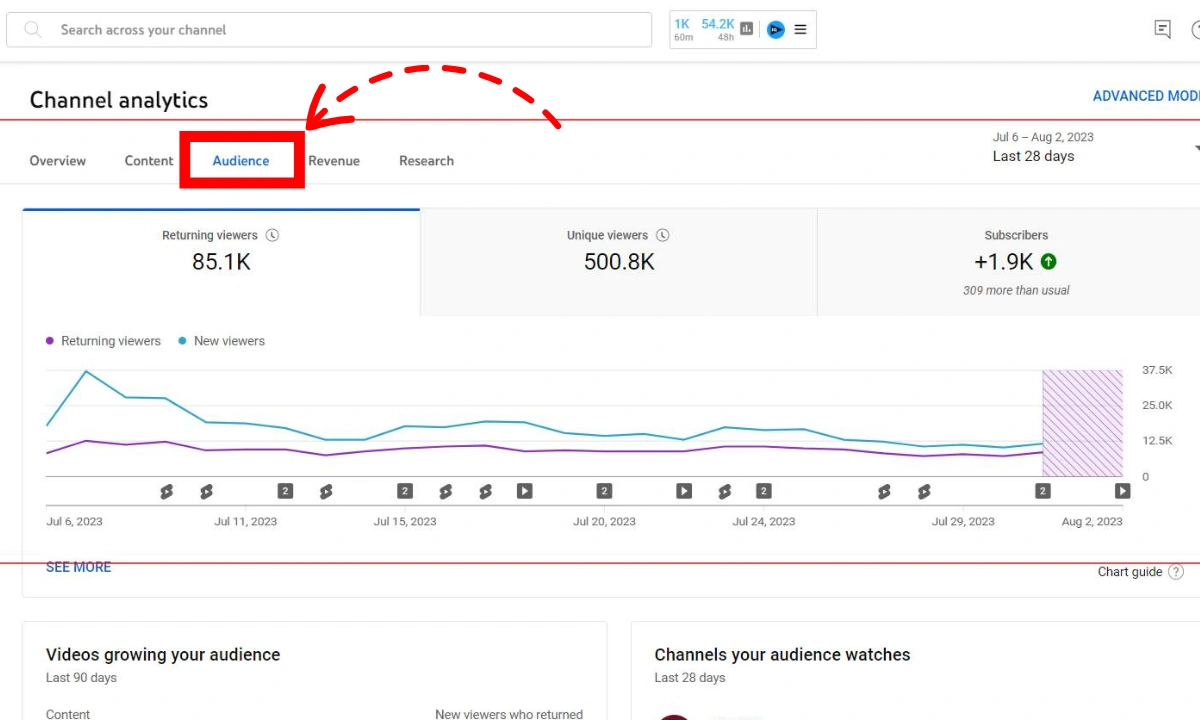
The Audience by Watch Behavior Card in Studio Analytics This card breaks down viewer behavior into two critical signals:
- Decreasing regular viewers — indicates the channel is no longer serving the need that originally drove retention. Long-term fans are tuning out.
- Decreasing new and casual viewers — indicates the content is not attracting a broader audience beyond the existing subscriber base.
Understanding which of these two groups is declining gives creators a much clearer direction for what to address first.
Step 3: Match Evaluation Metrics to Content Intent
One of the most practically useful points in YouTube's guidance is a reframing of how creators should judge performance in the first place. YouTube explicitly advises against using a single popular video as the universal benchmark for every piece of content.
Different videos serve different strategic purposes — and should be evaluated accordingly.
| Content Type | Primary Success Metrics |
|---|---|
| Community-building video | Subscribers gained, average view duration |
| Tentpole / broad reach video | Impressions, CTR, new viewer acquisition |
| Evergreen tutorial | Long-term search traffic, watch time over 90 days |
| Trend-response video | Views in first 48 hours, audience retention curve |
YouTube recommends that creators establish baseline performance expectations for each content type or series — not just compare everything to their best-performing video. Baselines help identify genuine underperformers and pinpoint which specific elements (title, thumbnail, hook, topic) may have contributed to the gap.
Rescuing Underperforming Videos
For videos that fall below baseline expectations, YouTube suggests several practical interventions:
- Promote the video on other social media platforms
- Add end screens from high-traffic videos pointing viewers toward the underperforming one
- Experiment with a revised title or thumbnail
- Create a Community post promoting the video to existing subscribers
Step 4: Factor Seasonality Into Channel Planning
Watch time does not move in a straight line — and YouTube's guidance acknowledges this directly. Different audiences have meaningfully different viewing habits depending on the time of year, and creators who ignore this pattern will regularly misread normal seasonal dips as performance problems.
YouTube advises creators to consider the following about their audience before drawing conclusions from a dip in numbers:
- Which countries are they primarily in?
- Are they students affected by school calendars?
- Are there major local or global holidays approaching?
- What life events might be pulling attention away from content consumption?
Rather than treating off-peak periods as failures, YouTube frames them as strategic opportunities — time to relax, refresh the content strategy, or build a library of evergreen content that will generate steady traffic during quieter periods and accelerate growth when the audience returns.
Step 5: Make One Change at a Time
Perhaps the most practical piece of advice in YouTube's guidance is also the most frequently ignored: make one change at a time.
Creators who simultaneously change their thumbnail style, upload frequency, video length, and topic focus have no way of knowing which variable caused a subsequent shift in performance. YouTube recommends isolating each change so its individual impact can be clearly measured before the next adjustment is made.
YouTube also offers a reframing that many creators will find reassuring: a single underperforming video does not damage a channel. What drives sustained channel-wide decline is not one bad video — it is a pattern of videos that viewers consistently choose not to watch when recommended, or a broader shift in audience interests that the creator has not yet adapted to.
The Bigger Picture: What Actually Causes Long-Term Watch Time Decline
YouTube's guidance makes clear that algorithmic suppression is rarely the actual cause of a sustained watch time drop. The two factors most commonly responsible are:
- Audience interest drift — the topics or formats that originally attracted viewers have evolved, and the channel has not evolved with them
- Reduced viewer response to recommendations — when most viewers stop watching a channel's videos when those videos are suggested to them, overall channel performance falls regardless of upload frequency or production quality
Both of these are content and strategy problems — not technical ones. And both are diagnosable using the tools YouTube has made available in Studio Analytics.
Key Takeaway
YouTube's official guidance on watch time drops is a reminder that channel performance is almost always a reflection of content strategy decisions, not mysterious algorithmic forces. By auditing recent channel changes, monitoring audience behavior through the right Studio metrics, aligning evaluation criteria with content intent, accounting for seasonality, and testing one variable at a time, creators have a clear and actionable path to diagnosing and recovering from any dip in performance. The data is already available in YouTube Studio — this guidance tells creators exactly where to look.
Source: YouTube Creator Academy — "Understanding Changes in Watch Time" Published guidance from YouTube's official creator education team.